
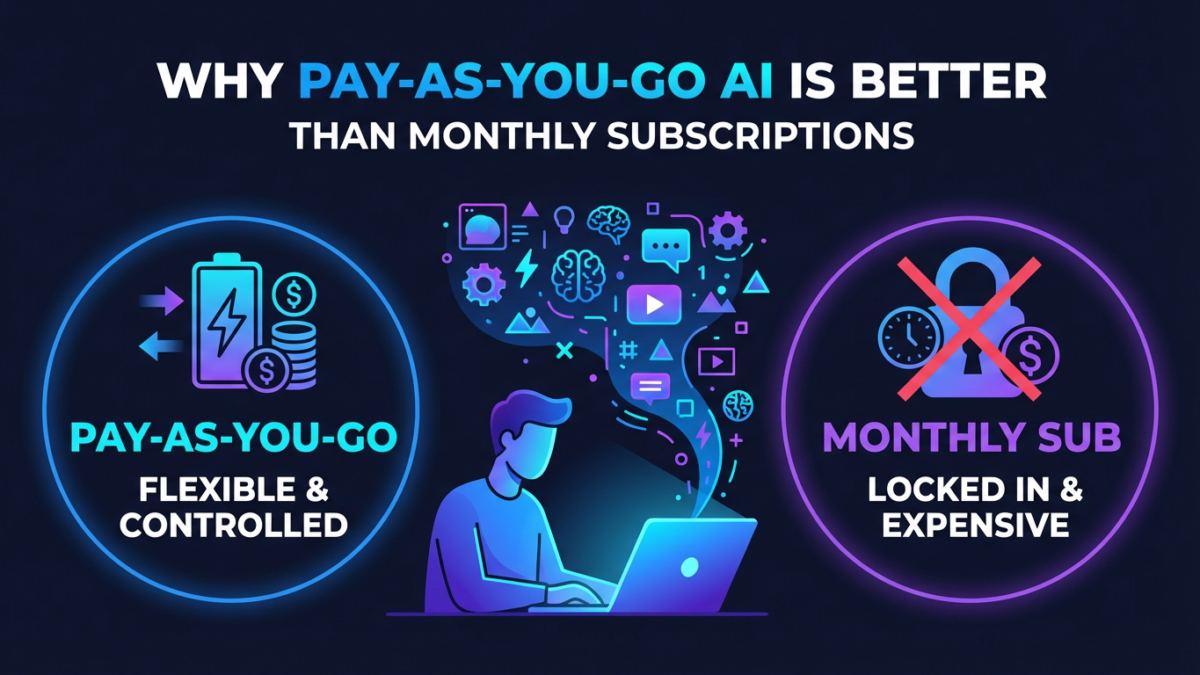
You’re paying $20 a month for an AI subscription. You use it heavily for one week to finish a project, then barely touch it for the next three. At the end of the month, you’ve used maybe 15% of what you paid for — and the billing cycle resets.
Sound familiar? You’re not alone — and the biggest names in AI are starting to acknowledge this problem publicly.
The conversation around how we pay for AI tools has shifted. It’s no longer just a pricing preference — it’s becoming a structural question about sustainability, fairness, and who actually benefits from the current model. The answer increasingly points in one direction: pay-as-you-go.
The Subscription Model Is Cracking Under Its Own Weight
The economics of flat-rate AI subscriptions have never quite added up — for providers or users.
Reports from late 2024 indicated that OpenAI was on track to lose roughly $5 billion that year despite generating an estimated $3.7 billion in revenue. The cost of running large language models at scale — compute, energy, infrastructure — is enormous and growing. Flat monthly pricing was a land-grab strategy: get users in the door, figure out monetization later.
That “later” is arriving. OpenAI has steadily expanded its pricing tiers: the $20/month Plus plan, a $200/month Pro plan, and a more affordable tier reportedly in development. More tiers, more segmentation, more decisions for users to navigate. That’s not simplification — it’s complexity dressed up as choice.
OpenAI CEO Sam Altman has spoken publicly about the idea of charging for AI the way utilities charge for electricity — based on actual consumption rather than flat fees. Whether or not OpenAI implements this fully, the signal is clear: the people building these systems recognize that flat pricing doesn’t map well to how people actually use AI.
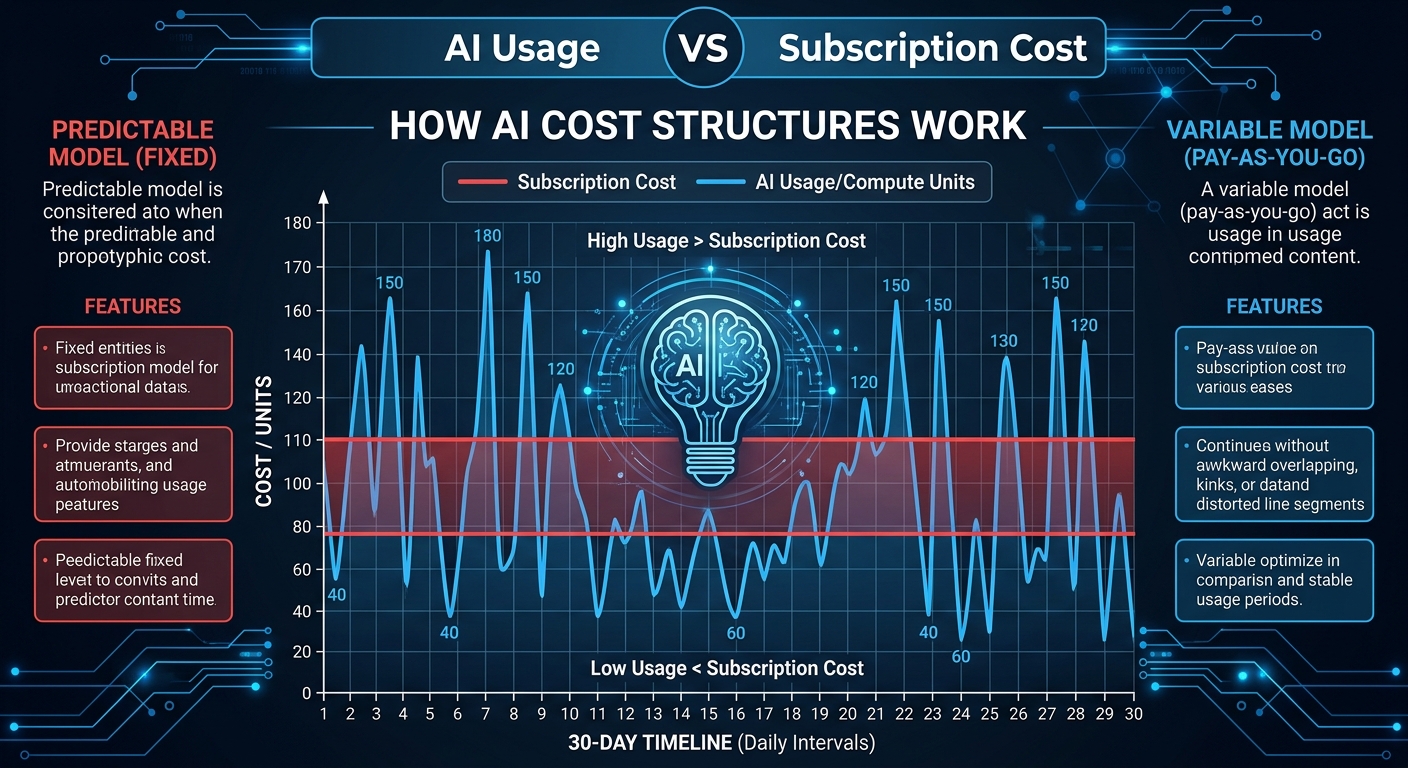
Why does this matter to you? Because flat subscriptions were never designed around your usage patterns. They were designed around average usage — which means the platform benefits from the gap between what you pay and what you consume.

Pay-As-You-Go Isn’t Just Cheaper — It’s Structurally Smarter
The financial argument for pay-as-you-go is straightforward, but the strategic argument is stronger.
When you pay per use, you can route tasks to the right model at the right price — not just whichever model your subscription gives you access to. This is where the savings get serious.
The API pricing landscape as of mid-2025 shows dramatic variation:
- Lightweight models designed for simple tasks (like Google’s Gemini Flash or similar economy-tier models) can cost as little as $0.075–$0.30 per million input tokens
- Mid-range models suitable for most professional tasks run $1–$3 per million input tokens
- Premium reasoning models can cost $5–$15 per million input tokens
That’s potentially a 20x–50x price difference between the cheapest and most expensive option. If you’re summarizing meeting notes or drafting social media captions, you don’t need a premium reasoning model. You need something fast and affordable that gets the job done.
Developers who’ve adopted this approach — using model-routing logic to match tasks to appropriate models — regularly report cutting AI costs by 50–80% compared to fixed-tier subscriptions. The principle is simple: use expensive models only when the task demands it, and affordable models for everything else.
That’s not a trick. That’s just paying for what you actually need.
The problem for most non-technical users? Setting up API access, managing model selection, handling authentication, and keeping everything inside a usable interface is a real engineering challenge. Which is exactly the gap that OximoAI was built to fill.
How OximoAI Makes Pay-As-You-Go Accessible
OximoAI operates on a coin-based system — you buy credits, you spend them when you use the bot, and you don’t pay for idle time. No monthly fee, no annual commitment, no charges accumulating while you’re on vacation.
Packages start from 99 ₽, and new users get 30 coins for free just by starting the bot — no card required.
But the more interesting part is what those coins unlock: access to multiple AI models across text, image, and audio — all from a single Telegram interface.
Here’s a concrete example:
Scenario: You’re a freelance content creator. You need a product description rewritten in a conversational tone, a header image for the post, and a short audio version for a podcast snippet.
- Open @OximoAI_bot in Telegram
- Select a text model suited to your task — choose based on the tone and complexity you need
- Send your original text, specify the tone (professional, casual, punchy), and get a rewritten version in seconds
- Switch to the image generation section, pick a model optimized for photorealism or stylized output, and describe your image concept
- Get your image in under 20 seconds
- Use the text-to-speech feature to generate an audio version of your description
Three different output formats. Multiple AI models. One interface. You paid only for what you used — not a flat monthly fee that assumes you’ll need this every day.
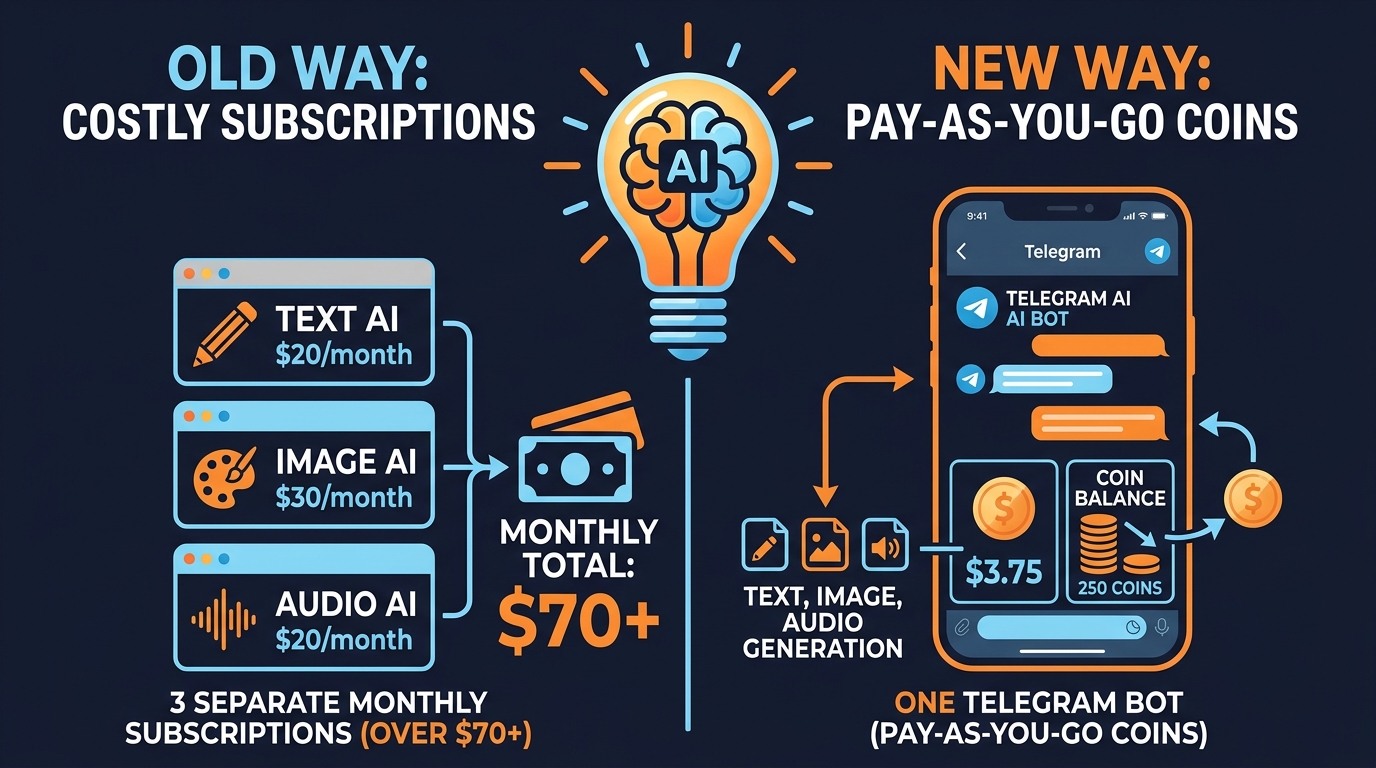
Compare that to managing separate subscriptions for a text AI tool, an image generation tool, and an audio platform. You’d easily spend $60–80/month across three different services with three different login systems — whether you use them heavily or not.
The Practical Reality: Who Should Switch and When
Pay-as-you-go isn’t the right model for every user in every situation. If you’re running a high-volume, consistent operation — thousands of AI calls per day, every day — a negotiated enterprise plan might still make sense.
But for the majority of individuals and small teams, the math almost always favors consumption-based pricing.
You’re likely overpaying on a subscription if:
- Your AI usage fluctuates significantly week to week
- You use AI primarily for one type of task — writing, or images, or audio — not all of them constantly
- You’re paying for multiple AI subscriptions across different tools
- You’re a freelancer or small business owner whose workload varies month to month
- You’re still figuring out which AI tools you actually need
Pay-as-you-go makes particular sense for:
- Content sprints — producing a lot in a short window, then pausing
- Experimenting with different models before committing to a workflow
- Teams with uneven usage across members
- Anyone who wants access to premium models without paying for a full subscription tier bundled with features they’ll never use
The broader industry trend reinforces this. As inference costs drop — and they’ve been falling fast throughout 2024 and 2025 — the value proposition of flat subscriptions weakens further. You’re increasingly paying for bundled access to capabilities you don’t need.
The Fairest Pricing Model Follows Your Usage
The direction of the AI industry is clear. The comparison of AI to a utility — something you pay for based on consumption — reflects a structural reality that flat subscriptions can’t sustain indefinitely as model costs evolve and usage patterns diversify.
For users, the shift is already underway. The question isn’t whether consumption-based pricing will grow — it’s whether you’ll benefit from it now or keep overpaying in the meantime.
OximoAI is built around this idea: access to top AI models for text, image, and audio, charged only when you use them, all in one place that works wherever Telegram works. No VPN needed, no separate accounts, no idle subscription costs.
Start for free — 30 coins, no card required — and see how much you actually use before spending anything.